
What to Consider When Comparing Mortgage Options

The interest rate matters—but it’s only one part of the picture. Understanding the differences between mortgage options can help you choose financing that better fits your goals, budget, and plans for the future.
By Sandy Biondo | Consolidated Lenders Group

When you're shopping for a mortgage, it's easy to focus on one number:
The interest rate.
While the rate is certainly important, it doesn't tell you everything about a mortgage.
Two loan options can have similar interest rates but very different monthly payments, upfront costs, mortgage insurance requirements, loan terms, or other features.
That's why comparing mortgage options means looking at the whole picture—not just the advertised rate.
1. Start With the Interest Rate
Your mortgage interest rate affects the amount of interest you'll pay to borrow money and is an important factor in determining your monthly principal-and-interest payment.
Generally, a lower interest rate means a lower cost of borrowing when the other loan terms are the same.
But rates can also be affected by factors such as the type of loan, loan term, down payment, credit profile, points or lender credits.
So rather than looking at the rate alone, consider what comes with it.

2. Compare the Monthly Payment
Knowing what a mortgage will cost each month is important when determining whether it comfortably fits your budget.
But make sure you're comparing the complete estimated housing payment, not simply principal and interest.
Depending on the property and financing, the monthly cost may include:
Principal + Interest + Property Taxes + Homeowners Insurance + Mortgage Insurance (if applicable) + HOA dues (if applicable)
A loan with an attractive principal-and-interest payment may feel very different once the other costs of homeownership are included.
3. Look at the Loan Term
Mortgage options can also have different repayment periods.
A longer loan term may result in a lower monthly principal-and-interest payment, but it can also mean paying interest over a longer period.
A shorter term may have a higher monthly payment but could allow you to repay the mortgage sooner and potentially pay less interest over the life of the loan.
Neither is automatically better.
The right choice depends on your budget and financial goals.
4. Consider Your Down Payment
The amount you put down can affect several parts of your mortgage.
Depending on the loan program and your circumstances, your down payment may influence your:
Loan amount • Monthly payment • Mortgage insurance • Interest rate • Cash needed at closing
And remember—you don't necessarily need to put 20% down to purchase a home.
Sometimes putting more down makes sense. In other circumstances, keeping more money available for closing costs, emergencies, repairs or other financial needs may be important.
The goal is to find an appropriate balance for your situation.
5. Understand Mortgage Insurance
Some mortgage options require mortgage insurance, particularly when the borrower makes a smaller down payment.
Mortgage insurance protects the lender against certain losses if the borrower doesn't repay the loan. The rules and costs vary depending on the type of mortgage.
Rather than automatically dismissing a loan because it includes mortgage insurance, compare what the entire financing option looks like.
A lower-down-payment option with mortgage insurance could make sense for one buyer while a larger down payment could be preferable for another.
6. Compare Closing Costs
Your mortgage payment isn't the only cost to consider.
Mortgage transactions can include lender fees, third-party charges, prepaid expenses and other closing costs.
This is where the Loan Estimate becomes particularly helpful.
For covered mortgage applications, lenders generally provide a standardized Loan Estimate that shows important information about the proposed mortgage, including the estimated interest rate, monthly payment and closing costs.
When comparing Loan Estimates, look beyond the amount listed as Cash to Close and understand what is contributing to that number.
7. Understand Points and Lender Credits
Sometimes borrowers are presented with different combinations of interest rates and upfront costs.
Discount points generally involve paying more upfront in exchange for a lower interest rate.
Lender credits work in the other direction: you may receive a credit toward closing costs in exchange for accepting a higher interest rate.
Neither approach is automatically good or bad.
How long you expect to keep the mortgage can play an important role in deciding whether paying additional money upfront for a lower rate makes sense.
8. Look at the APR—But Understand What It Means
You'll probably also see an Annual Percentage Rate, or APR, when reviewing mortgage options.

The APR is different from the interest rate. It incorporates the interest rate and certain additional loan costs into a percentage designed to help consumers compare borrowing costs.
It can be a useful comparison tool, but it shouldn't be the only factor you consider.
The CFPB recommends comparing several pieces of information on the Loan Estimate - including the interest rate, monthly payment, upfront loan costs, lender credits and the five-year cost of borrowing.
9. Think About How Long You Plan to Keep the Loan
This part is easy to overlook.
A mortgage that makes sense for someone planning to stay in a home for 20 years may not be the same option that makes sense for someone who expects to move in a few years.
Ask yourself:
How long might I live here?
Could I refinance or sell before the loan is paid off?
Is lowering my upfront cost more important, or am I willing to pay more upfront for potential savings over time?
Your future plans can change, of course. But considering what you know today can help you make a more informed comparison.
Don't Compare Just One Number
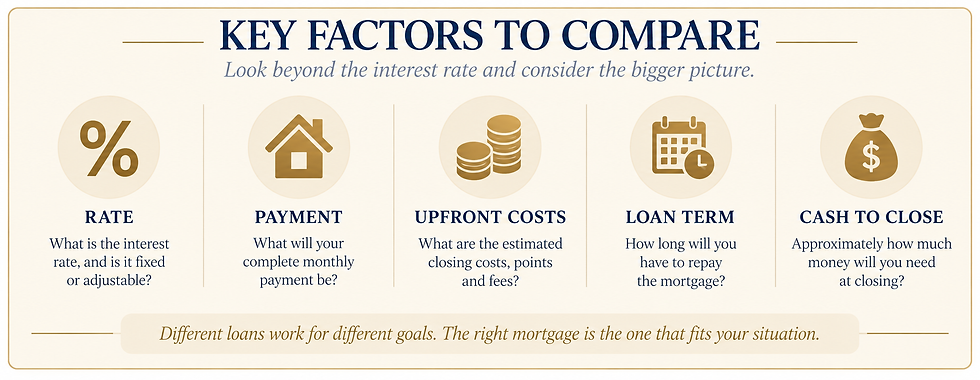
When reviewing mortgage options, consider these pieces together:
INTEREST RATE
What is the rate, and is it fixed or adjustable?
MONTHLY PAYMENT
What will the complete estimated housing payment look like?
UPFRONT COSTS
What are the estimated closing costs, points and lender fees?
CASH TO CLOSE
Approximately how much money will you need at closing?
LOAN TERM
How long will you have to repay the mortgage?
MORTGAGE INSURANCE
Is it required, how much does it cost, and how does it work for this particular loan?
LONG-TERM COST
How might this option fit with the amount of time you expect to keep the mortgage?
The “Best” Mortgage Isn't Necessarily the Same for Everyone
There isn't one mortgage that's automatically best for every borrower.
One buyer may prioritize keeping their monthly payment as low as possible.
Another may want to minimize upfront costs.
Someone else may prefer a shorter loan term or want to preserve more of their savings after purchasing the home.
A good mortgage comparison isn't simply about finding the lowest number. It's about understanding how the numbers work together and choosing an option that fits your circumstances and goals.
Need Help Comparing Your Options?
Mortgage terminology and loan estimates can be confusing, especially when several options look similar at first glance.
Sandy can help you review available financing options, understand the differences, and talk through the factors that may matter most for your particular situation.
You don't need to understand every mortgage term before you reach out. That's what the conversation is for.

Every borrower's situation is different. Loan programs, rates, terms, eligibility requirements, mortgage insurance requirements and costs vary. This information is provided for general educational purposes and is not a commitment to lend.


Comments