
Is It Time to Refinance? 6 Things to Consider Before You Decide

Refinancing can change your interest rate, monthly payment, loan term or access to home equity - but that doesn't automatically mean it's the right move. Looking at your current mortgage, the costs of refinancing and your longer-term plans can help you make a more informed decision.
By Sandy Biondo | Consolidated Lenders Group

If you've had your mortgage for a while, you may have wondered:
“Would refinancing make sense for me?”
It's a reasonable question.
Interest rates change. Home values change. Your income, expenses and financial priorities can change too.
But deciding whether to refinance involves more than comparing your current interest rate with a new one.
A refinance replaces your existing mortgage with a new loan, which means there may be new costs, a different loan term and other financial considerations.
Before deciding, here are six things I encourage homeowners to consider.
1. What Are You Trying to Accomplish?
Before looking at rates or loan programs, start with your goal.
Are you hoping to:
Reduce your monthly payment?
Change your interest rate?
Pay your mortgage off sooner?
Move from an adjustable-rate mortgage to a fixed-rate mortgage?
Access some of your home's equity?
Change another feature of your existing financing?
Different goals may lead to very different refinance options.
The first question shouldn't necessarily be “What's today's rate?” It should be “What do I want this refinance to accomplish?”
2. How Does the New Loan Compare With Your Current Mortgage?

Your existing mortgage provides the starting point.
Look at factors such as your:
Current interest rate
Remaining loan balance
Monthly principal-and-interest payment
Remaining loan term
Current loan type
Then compare those with the proposed new mortgage.
A lower interest rate can be beneficial, but the interest rate alone doesn't tell you whether refinancing makes financial sense.
Look at the entire loan.
3. What Will the Refinance Cost?
Refinancing generally isn't free.
Depending on the transaction, there may be lender charges, appraisal or valuation costs, title and settlement-related costs, government charges and other expenses.
Sometimes certain costs may be incorporated into the financing or offset in other ways, but that doesn't necessarily mean the refinance has no cost.
Understanding both your upfront costs and longer-term borrowing costs is important.

4. How Long Do You Expect to Keep the Loan?
This is an important consideration that homeowners sometimes overlook.
Suppose refinancing would reduce your monthly payment, but completing the refinance requires additional closing costs.
One useful calculation is how long it could take for the monthly savings to offset those upfront costs.
This is sometimes called a break-even period.
A simple starting calculation is:
Refinance Costs ÷ Estimated Monthly Savings = Approximate Break-Even Period
For example, if applicable refinance costs were $4,000 and the new loan reduced the relevant monthly payment by $200:
$4,000 ÷ $200 = approximately 20 months
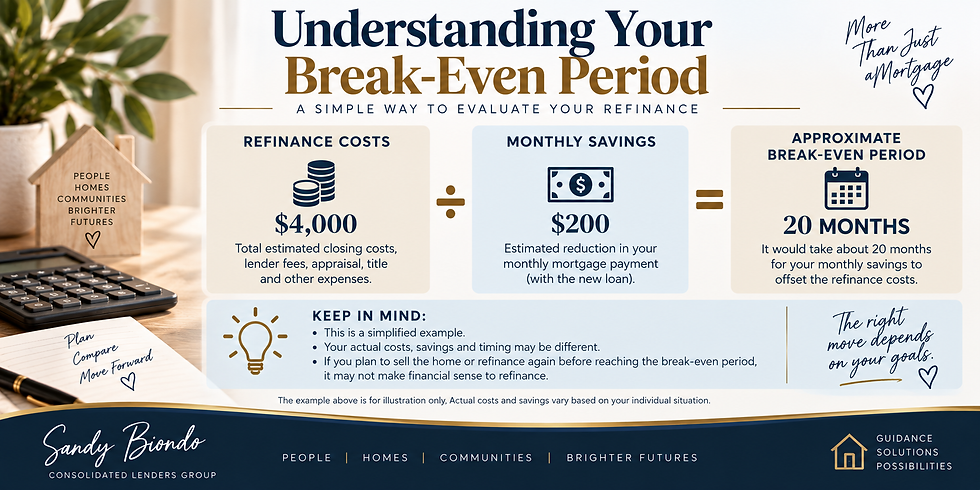
That's only a simplified example. Your actual comparison may involve other changes to the loan and costs.
If you expect to sell the property or refinance again relatively soon, that timing may affect whether the transaction makes sense.
5. Are You Changing the Length of Your Mortgage?
This is a big one.
A refinance may give you the opportunity to change your loan term.
Shortening the term
A shorter loan term may help you pay the mortgage off sooner and can reduce total interest in some circumstances, but the monthly payment may be higher.
Extending or restarting the term
A longer term may reduce the required monthly principal-and-interest payment.
However, extending the repayment period can increase the total finance charge or interest paid over the life of the loan, even when the new interest rate is lower.
That's why it's important to compare both:
“What will my payment be?”
and
“What could this loan cost me over time?”
6. Are You Considering Taking Cash Out?
If your home has sufficient equity, certain refinance options may allow qualified homeowners to borrow more than the amount needed to pay off their existing mortgage and receive some of the difference in cash.
This is commonly called a cash-out refinance.
Homeowners may consider accessing equity for purposes such as home improvements or other financial needs.
But there is an important distinction:
Home equity isn't the same as cash sitting in a savings account.
Borrowing against your equity creates additional debt secured by your property.
If you're considering using mortgage proceeds to pay other debts, remember that you may be converting debt that was previously unsecured into debt secured by your home.
Before doing that, consider the interest rate, loan term, costs, new payment and total borrowing implications carefully.
What About Switching From an ARM to a Fixed Rate?
Some homeowners refinance because they want to change the structure of their mortgage rather than simply lower their rate.
For example, someone with an adjustable-rate mortgage may want to explore a fixed-rate mortgage for greater payment predictability.
In other circumstances, borrowers may consider different loan structures.
The important thing is to understand how the new loan works, how it differs from your existing mortgage and what risks or benefits may come with the change.
A Lower Rate Doesn't Automatically Mean a Better Refinance
This is probably the biggest takeaway.
Imagine seeing an advertised mortgage rate lower than the rate on your current mortgage.
It can be tempting to immediately assume:
“I should refinance.”
But you still need to consider:
Closing costs
Remaining term on your current loan
Term of the new loan
Monthly payment difference
How long you expect to keep the mortgage
Total borrowing costs
Your personal financial goals
Sometimes refinancing may make sense.
Sometimes keeping your existing mortgage may be the better choice.
And sometimes it's worth reviewing the numbers now and deciding to revisit the conversation later.
Start With a Mortgage Review, Not an Assumption
You don't have to decide whether you want to refinance before talking with Sandy.
Start with what you already have.
Your current mortgage information, your goals and your future plans provide a much better starting point than simply asking whether today's rates are higher or lower.
With decades of mortgage and real estate financing experience, Sandy can help you compare your existing mortgage with potential refinancing options and understand the differences.
The goal isn't to refinance simply because you can. It's to understand whether doing so makes sense for you.
Wondering Whether It's Time to Refinance?
If you're considering refinancing your home, Sandy can help you review your current mortgage, discuss what you'd like to accomplish and explore financing options that may be available based on your circumstances.
Bring your questions. Start with the numbers. Then decide whether refinancing fits your goals.

Disclaimer
This information is provided for general educational and informational purposes only and is not intended as financial, legal, tax, or investment advice. Every borrower's situation is different. Loan programs, rates, terms, eligibility requirements, property requirements, and costs are subject to change and may vary based on individual circumstances. All loans are subject to applicable underwriting and approval requirements. Borrowing against home equity creates debt secured by your property and may increase your total borrowing costs. Refinancing may increase the total finance charge over the life of the loan. This information is not a commitment to lend or a guarantee of loan approval. Please contact Sandy Biondo at Consolidated Lenders Group, Inc. to discuss your individual financing needs.


Comments